Function
Staff
UA-RPO envisions itself as a service unit committed to:
- Help concretize the University’s vision-mission and goals through excellent research services in the University and its immediate community;
- Assist in making research an integral part of all academic and professional activities in the institution, thereby making researcha way of life in the University;
- Promote research as a tool in effectively enhancing relevant and meaningful instruction;
- Assist in creating a proactive and productive research culture that strongly encourages the conduct of scholarly research;
- Disseminate findings of completed research outputs and other research information; and;
- Promote the values of patience, prudence, diligence, respect, humility and congeniality, and the observance of the highest ethical standards in research-related activities, while maintaining the academic atmosphere.
Agenda, Policies and Programs
Research Agenda Framework
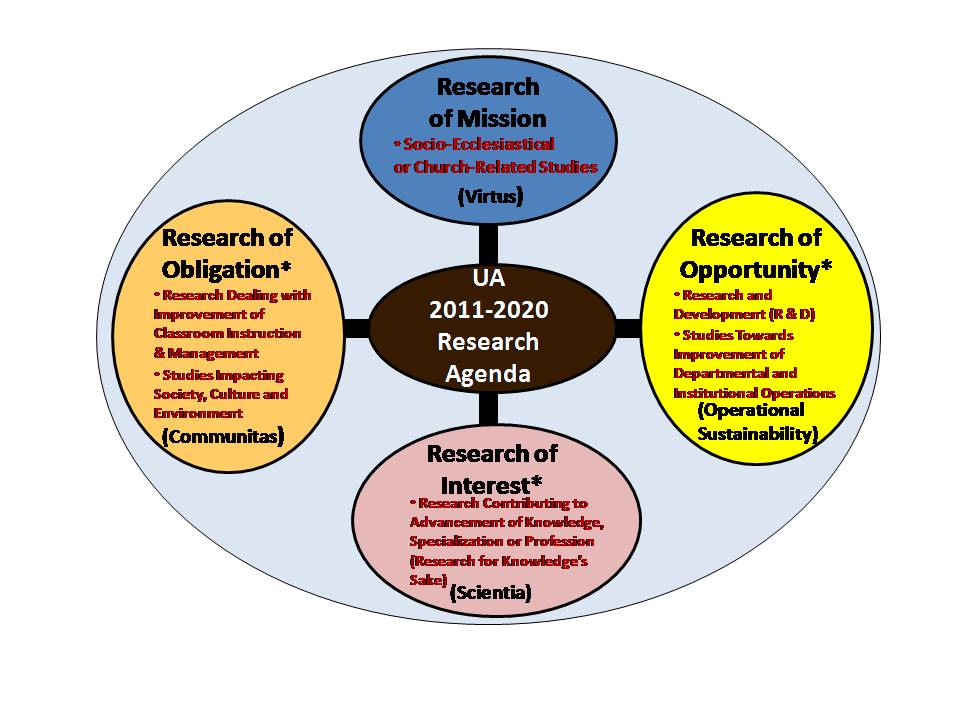
The 2011-2020 Research Agenda is structured around four clusters broken down into six key priority areas. The six key priority areas are:
- Socio-Ecclesiastical/Church- related studies;
- Research dealing with improvement of classroom instruction and management
- Studies impacting society, culture and environment; Research and Development (R&D);
- Studies towards improvement of departmental and institutional operations; and
- Research contributing to advancement of knowledge, specialization or profession.
Research of Mission
The University shall espouse the promotion of Socio-Ecclesiastical Research to acquaint the faithful with some of the issues and concerns faced by the Church, in general. The University of the Assumption, as an archdiocesan school is called to be a witness in the Church mission (as stipulated in the General Objectives of UA) As such, the Research and Planning Office (RPO) shall recognize that within the realm of academic inquiry, lays the intersection of both religious and socio-cultural aspects. In this respect, RPO shall propagate research designed to aid the Church in addressing some of the social, cultural and ecclesiastical issues that are critical in the fulfillment of her mission.
The Catholic Church plays a significant role not only in the private lives of the believers, her influence encompasses a larger sphere, particularly, matters of national and global consequence. Thus, studies intended for the purpose of providing the church pertinent facts and figures to enable the church leaders in arriving at critical resolutions shall be advocated by UA-RPO.
Moreover, Vatican II underscored the indispensable and utilitarian component of research in pastoral work. This was intricately laid down in the Pastoral Constitution on the Church in the Modern World, where it emphasized that “In pastoral care, sufficient use must be made not only of theological principles, but also of the findings of the secular sciences, especially of psychology and sociology, so that the faithful may be brought to a more adequate and mature life of faith.” Research areas are: databases for Church’s consumption, church organizational plans, ecclesiastical issues, support for theological and religious studies and promotion of Catholic teachings.
Research of Obligation
The University shall espouse the promotion of Socio-Ecclesiastical Research to acquaint the faithful with some of the issues and concerns faced by the Church, in general. The University of the Assumption, as an archdiocesan school is called to be a witness in the Church mission (as stipulated in the General Objectives of UA) As such, the Research and Planning Office (RPO) shall recognize that within the realm of academic inquiry, lays the intersection of both religious and socio-cultural aspects. In this respect, RPO shall propagate research designed to aid the Church in addressing some of the social, cultural and ecclesiastical issues that are critical in the fulfillment of her mission.
The Catholic Church plays a significant role not only in the private lives of the believers, her influence encompasses a larger sphere, particularly, matters of national and global consequence. Thus, studies intended for the purpose of providing the church pertinent facts and figures to enable the church leaders in arriving at critical resolutions shall be advocated by UA-RPO.
Moreover, Vatican II underscored the indispensable and utilitarian component of research in pastoral work. This was intricately laid down in the Pastoral Constitution on the Church in the Modern World, where it emphasized that “In pastoral care, sufficient use must be made not only of theological principles, but also of the findings of the secular sciences, especially of psychology and sociology, so that the faithful may be brought to a more adequate and mature life of faith.” Research areas are: databases for Church’s consumption, church organizational plans, ecclesiastical issues, support for theological and religious studies and promotion of Catholic teachings.
Research of Opportunity
Research & Development (R & D) studies are investigative and developmental design projects that the university chooses to conduct with the intention of making a discovery that can either lead to the development of new products, technologies or procedures, or to improvement of the same.
R & D is one of the means by which society can experience future growth by developing new products or processes to improve and expand the operations. Undertakings like these are in close collaboration with Department of Science and Technology (DOST), Department of Health (DOH) and Department of Energy (DoE), Department of Environment and Natural Resources (DENR),Congressional Commission on Science and Technology and Engineering (CCSTE) and research-based agencies. The University encourages research collaboration through collaboration agreements and consortia (with other schools universities). Being a member of Central Luzon Health Research and Development Consortium (CLHRDC), UA explores potential and feasible R & D projects in the field.
Technical Academic programs offered by the University such as Computer Science, Information Technology, Civil Engineering, Architecture, Electronic Engineering and Nursing are seminal houses where research and development (R &D) studies particularly on inventions, development of prototypes and patenting may sprout. The University through the Research and Planning Office in coordination with the Center of Information Technology and Laboratories (CITL), Science Department, College of Engineering, College of Nursing and College of Computing Sciences and Information Technology continuously identified areas of concern in the university needing technology. The development of digitized or automated programs, prototypes, health devices and innovative systems and mechanisms are some of the potential research undertakings. The Technology Transfer Committee (TTC) composed of representatives from the aforementioned colleges and offices monitors and evaluates R & D projects to ensure quality outputs. Research areas in R & D include: instructional material development, systems/methods/procedures development, inventions (development of prototypes and models) and product development.
Improvement of department and institutional operations is a crucial thrust of Quality Assurance (QA) in every academic institution. The University considers research as a vital mechanism that would ensure the continuous quality improvement of systems and procedures in the university. Research undertakings consistent to the Vision, Mission and Goals of the University of the Assumption and the National Higher Education Research Agenda-2 (NHERA) relative to the improvement of department/institutional operations are prioritized. Research areas include: evaluation of program and curriculum, graduate supply and demand studies, evaluation of marketing studies, extent of realization of departmental and university plans and activities, assessment on the satisfaction level of students and stakeholders on key services, appraisal and evaluation of current processes and systems and cohort studies.
Research of Interest
Every researcher has his own research interest. Basically, it stems from the area of specialization or profession and on the curricular offerings of the university. Professors who are fully engaged in instruction of a course or subject have a natural inner drive in advancing the frontier of knowledge in their area of discipline.
As accreditation and certification of academic programs become an indispensable criterion of the culture and seal of excellence of a school, the academic community naturally yearns and seeks for advancement of knowledge not just in the area of discipline but also in the area of interest. Faculty members are encouraged to develop their own niche, to become experts in the respective field through research. Thus, studies in the area of specialization are a crucial matter to many serious professors/teachers who are engaged in teaching their course of expertise.
Aware of this fact, the University of the Assumption has encouraged professors and teachers to conduct faculty research undertakings in the area of specialization. Alignment with the degree program in their academic advancement and research undertaking has been an invaluable professional pursuit. Paper presentations in local and international forums would necessitate the alignment of research topic with the area of discipline or at least with what the professional organization’s thrust and the research interest which the researcher wants to explore.
As developer and creator of knowledge, it is inherent for an educator to explore the arena of interest through the rigor of selecting relevant research topics without compromising the standards of quality research set by the University.
The University encourages multidisciplinary and collaborative research undertakings among faculty especially on relevant topics that necessitate teamwork and multiple disciplines. The Research and Planning Office encourages the adoption of these approaches namely: multidisciplinary, interdisciplinary and transdisciplinary in the conduct of research, particularly collaborative research projects. Most faculty research outputs are self-funded and the faculty is the one that shoulders the cost of the undertaking. The approved Incentive Program for Faculty Research (IPFR) is one of the concrete strategies which may propel teachers to engage in research. Faculty research proposals with proposed budget for the undertaking must be submitted subject to the approval of the University Research
Council. Every facultymay avail financial support for local and international paper presentation subject to the recommendation of the RPO based on merit review and approval of the University Research Council.
Research areas contributing to the advancement of knowledge, specialization or profession include: Theology; Education & Educational Policy; Psychology & Counseling; Health & Sciences; Business & Management; Tourism; Engineering & Architecture; Computer Technology; Philosophy; Economics; Humanities, Languages, and other related curricular course offerings.
Programs and Services
Research Consultation
The Research and Planning Office renders research consultation to faculty regarding their proposal. All RPO researchers have the duty to accommodate every faculty involved in research.
- An appointment is scheduled prior to formal visit to the RPO.
- Faculty members are provided with information and tips by the designated researcher on how to write their research proposals (e.g. Power calculators in computing sample size)
- Guidelines, standards, and templates in the conduct if research are also provided to them.
Validation of Survey Instruments / Tests
Data Analysis via SPSS
Plagiarism Scanning Services
Link to PlagScan Service PDF
Propelled by the University’s vision-mission and goals, RPO seeks to accomplish its own vision and mission by:
- Propelling faculty research productivity in a collaborative fashion;
- Building faculty research capability;
- Formulating, implementing, monitoring, evaluating and reformulating the faculty incentive program, research development plans and action plans;
- Spearheading the formulation/ reformulation, review and amendment of guidelines and policies governing the conduct ofresearch in the University;
- Supervision of, providing assistance to and monitoring research projects/ undertakings in the University;
- Serving as a clearinghouse of salient research findings and information for dissemination to both internal and external users;
- Ensuring proper and uniform implementation of research policies and guidelines across colleges/department;
- Assisting in the supervision of research classes;
- Extending community & professional services through research collaborations and consortia;
and, - Serving as a lead unit in planning and evaluation of institutional programs and undertakings.
Extension and Utilization
Research and Extension for the Diocesan Pastoral Planning of the Ecclesiastical Provinces
The University of the Assumption was commissioned to participate in the study along with the other nine equally prestigious Catholic Universities in the Philippines. The study, “An assessment of the diocesan Pastoral Plans in the light of the second Plenary Council of the Philippines” was a national undertaking that commenced in April 2011 and culminated in the reports’ presentation at the Bishops’ regular assembly on January 24, 2012 in Pope Pius Catholic Center, Manila. Assigned to UA was the assessment of the diocesan pastoral plans (DPPs) of the ecclesiastical provinces of Nueva Segovia and Tuguegarao. With the able leadership of the ARO Director, 19 UA faculty-researchers had voluntarily assisted in the assessment of the DPPs. Data were content-analyzed and reports were prepared by research team. Mrs. Dianne Pangilinan and Dr. Ruth Balajadia Ducut took the charge of consolidating and writing the reports covering the two ecclesiastical provinces. Hence, two volumes of research reports were produced and submitted to the CBCP.
Research and Extension for the Filipino Catholic Youth
The National Filipino Catholic Youth Study 2014 is a research project commissioned by the Catholic Bishop’s Conference of the Philippines (CBCP), Episcopal Commission on Youth (ECY) and the Catholic Educational Association of the Philippines (CEAP) in collaboration with 18 universities and colleges nationwide.
The University of the Assumption is privileged to be one of the lead members of the research team commissioned to undertake the project. The Director of the Research and Planning Office, the Dean of the Graduate School of the University, the Director of the Outreach Ministry, and other administrators became the frontline research collaborators of the project. Services were extended through actual field surveys and the facilitation of focus group discussions among the youth of North Luzon. Data analysis and writing of the findings for North Luzon were assigned to the University of the Assumption through leadership of Dr. Arnel T. Sicat.
Dr. Ruth Balajadia-Ducut, being one of the regional research coordinators was privileged to present at the Plenary of the CEAP National convention in Cebu City in September 2013, at the mid-year Plenary Assembly of the Catholic Bishops’ Conference of the Philippines in Manila in July 2014. Said study was also presented in a number of conferences of educators and youth ministers nationwide. A qualitative study, which an offshoot of the national study entitled,“What in stores for the youth in ASEAN Economic Community (AEC)” was presented by Dr. Arnel T. Sicat and Dr. Ruth Balajadia-Ducut in the National Page Conference at the University of Sto.Tomas.
Research and Extension for the Local Government’s Planning, Policy Making and Program Development
The University of the Assumption in partnership and collaboration with the City Government conducted two surveys, the2009 and the 2013 CSFP Household Socio-Economic Panorama Studiesin all the 35 barangays of the City of San Fernando. The project was fully funded by the City Government of San Fernando, and was signed through a Research Collaboration Agreement (RCA) between the Mayor Oscar S. Rodriguez and Fr. Joselito C. Henson in the year 2013, the incumbent President of the University in 2013 and Bishop Roberto C. Mallari in the year 2009.
The Academic Research Office (ARO, 2009) /Research Planning Office (RPO, 2013under the leadership of Dr. Arnel T. Sicat and the National Service Training Program (NSTP, 2009 & 2013) under the leadership of Mr. Rio Polintan were the project unit leaders who made the necessary preparations in the conduct of the survey. The NSTP faculty and the freshmen students across programs were formally trained to conduct surveys to all the 35 barangays in the City of San Fernando. They learned the research skills being field supervisors and survey enumerators of the project. But without the unparalleled assistance and support of the leaders of the local government and the barangay units the project would not be a success.
The study provided reliable and relevant updates about the general socio-economic status of the City. Specifically, it provided inputs in improving the City’s economic, health, literacy, shelter, employment and peace and order conditions among the less privileged residents.
Research and Extension for the Archdiocesan Pastoral Planning
The Archdiocese of San Fernando through the Office of the Archbishop, commissioned the University of the Assumption in the conduct of the following survey and assessment studies: (1) Profile of Catholics in Pampanga; (2) Focus Group Discussion with Parish Lay Leaders; (2) Assessment of the Parish Pastoral Plans in the light of the Archdiocesan Integrated Pastoral Plan 4.
The Institute of Theology and Religious Studies (ITRS) under the auspices of Fr. Oliver Yalung and the Research and Planning Office (RPO) under Dr. Arnel T. Sicat,lead the Assumption community in implementing the project. Selected research collaborators across colleges and offices were also involved in the data gathering and analysis of data. Students enrolled in the National Service Training Program participated actively in the conduct of the actualfield survey while faculty-researchers participated in analyzing pertinent data to generate findings and conclusions of the study.The findings of the study were disseminated to the parish priests in three separate clergy assemblies.
Research and Extension for the Information System of Local Barangays
A faculty-funded design study titled, “Barangay Constituents Information System (BCIS): Toward Achieving Organizational Efficiency”, was conducted to develop an automated system for the local barangays. To date, 21 barangays have acquired it and have been utilizing the system software that efficiently facilitates the regular issuing of barangay clearance and other documents. Mr. Jesus Figueroa, the programmer of the BCIS is one of the staff of the Center of Information Technology and Laboratories who continuously improve the system through the user’s feedback of the software.
According to the barangay captains, the system has helped in the facilitation of clerical work, issuance of documents and summarizing the census of the community. Generally, it is one of the systems that has supported the mandate of exercising organization efficiency in the barangay.
Extension and Utilization
| Local | Document | Area |
|---|---|---|
| Catholic Bishops Conference of the Philippines | MOA | Survey and Assessment Studies |
| Catholic Educational Association of the Philippines (CEAP) | MOA | Survey studies |
| Archdiocese of San Fernando | Pastoral Letters | Survey and Assessment studies |
| Social Action Center of Pampanga (SACOP) | MOU and MOA | Survey and Design Studies |
| Episcopal Commission on Youth | MOA | Survey Studies |
| City Government of San Fernando, City Planning and Development Office | RCA | Survey Studies |
| Central Luzon Health Research and Development Consortium (CLHRDC) | MOA | R & D on Health |
| Philippine Council for Health Research and Development (PCHRD) | MOA | R & D on Health |
| Department of Science and Technology | MOA | R &D on Technology |
| International | ||
| Siena Heights University, USA | MOU | Under exploration |
| Incheon Catholic University, Korea | MOU | Under exploration |
| Hannam University, Korea | MOU | Under exploration |
| ABCs for Global Health, USA | MOU | Ethics Review |
| Universitas Pendidikan Indonesia, Bandung, Indonesia | MOU | Research collaboration on dynamic software development in Education |
Organizational Chart